Monday, August 1, 2016
Cop gives "NO EXCUSES" for Record # of complaints..0 .. Check this out. ...
Is a traffic stop similar to what we do? I think so! Think of all the bad news we have to share such as poor test grades or bad attendance. I cannot emphasize this enough: Teachers, don't lose the humanity! You are human; students are human. Be understanding but be firm at the same time (like the police officer in the video). Tough love DOES have a LOVE component.


Monday, June 6, 2016
Cool website for animated gifs.
I love using gifs! (Please just don't ask me how to pronounce it. Gifs or jifs?) Animated gifs are clips either constructed by individuals or taken off television and movies. A good gif can add a megabyte or two to your Power Point but I think it's worth it. I use them in my Quizizz, Kahoot, and Power Points. Right now, the best website for animated gifs is www.giphy.com

How do you insert this into a Power Point? Don't copy and paste; it doesn't work. In most cases, you should be able to right-click it and save as. Save it just like any other jpeg. Then you can insert it into Power Point or upload it to Quizizz or Kahoot. Gifs really add an element to the lesson.
Friday, May 27, 2016
Using Zipgrade in Your Classroom
I hate paying for software. I pride myself on always finding a better, free version of everything. I made an exception this past year. I definitely do not regret it! Zipgrade is an app you can download on your iPhone or Android phone. Your students will complete a multiple choice exam on scantrons provided by their website. As students are finishing, you can walk around with your phone and scan their tests to give them instant feedback on their test. Here is a video demonstrating the app.
Zip Grade Demo from Joseph Bue on Vimeo.
One thing I love about this app is I can look for patterns immediately. When you scan a student's answer sheet, you will get instant feedback that looks like this:

Also, I like to tell the students which questions they missed so they can go back and correct them. I know this inflates the grade and skews the data but I'm more concerned about them learning the material than having accurate grades.
I did have a few minor problems. Sometimes I couldn't get an accurate scan. I wasn't sure if the lighting was too bright or too dark. I also had some students bubble E when they meant to bubble D. So be very mindful at the beginning of the year.
Overall, I love this app and the price ($6 per year). Now, I don't have to beg for thousands of dollars to replace my aging clickers. It's data-driven; it's very easy to use.
Raising Students' Standardized Test Scores

I get it! In the old days, teachers made their own tests; if students failed then it was because the student didn't try hard enough. Today, tests are a measure of teacher performance and, in some cases, a basis for a raise.
Since I'm not willing to fight the system by going to the state capitol and speaking in front of the school board, I'm going to focus on what goes on in my classroom. To those who are fighting the good fight, I applaud you. But high test scores gave me the only decent raise I ever received in my 13 years of public school education. This is how I do it.
First, find out what is on the test. If it's a state standardized test, google the name of the test and the word released and obtain all the released exams. In Texas, google "released starr eoc." In New York, google "released NY regents exam." Feel free to be more specific with grade and subject. For AP courses, you will need to access them on the College Board website after you log in as an instructor. Sadly, you can find some older released AP exams online. Is there a "blueprint" of the test, meaning a list of what topics will be covered on the test? If so, print it out! My biggest challenge in teaching AP Psychology has been figuring out what has generally been tested and what has not. Once you get a firm grasp, you can focus your instruction on those things.
Focus your lessons on what is on the test. This seems to be a no-brainer but it deserves emphasis here. If you decide to teach something that is not on the test, make sure it is interesting and/or valuable. For example, in my history classes I like to spend a few days teaching about the Kennedy assassination. I know it will not be on the test but I know my students are interested. A good example of this is World War II. Teachers and students love WWII. However, there is a difference between a World History class and a US History class in what to emphasize. Rosie the Riveter will probably not be on a World History test. Teach what you want, but have students take notes only over what is on the standardized test. Make sure your in-class exam has questions that match what's on your standardized test.
Know your students! After 4 or 6 weeks, give a well-written assessment that matches the difficulty of the standardized test you are preparing for. Take those student scores and do something with them. One of the most effective moves is to call each student up to your desk and talk to them about it. In a Title I school, many students will take a test, fail it, and put it out of sight and out of mind. Their parents will never hear of this test. You, the teacher, must call the student up to your desk and look directly at them and ask them, "Hey! You got a 47 on this test. What happened? [insert awkward pause here] Did you try? Or did you just blow it off?" As a teacher, this is where your people skills come in handy. At minimum, you need to instill the idea that the next time they take a test, they will need to try harder so they don't have to go up to the teacher's desk and have an awkward conversation. Ideally, you could go over the test with them and figure out if there is a pattern regarding which questions they missed. If they did well but missed the last third of the test, that probably means they got lazy and just bubbled in random answers. Ask them directly if that is what they did. If they admit to getting lazy at the end, then directly ask them, "Could you please not do that? It makes me look bad." I can hear your groans as you read this, but it works with the students that I teach. They won't do it for themselves, they won't do it for their parents, but they will do it for me!
After the second major test, the failure rate generally drops. Then I can focus on students who really need the help. At this point, I'll take a cue from homeschooling and work with the students individually or small groups. I try to assess whether the students did not know the material or was it the wording of the questions. This is a big deal since phrases like "the Silk Road facilitated the spread of Buddhism" can throw a LEP student. What does "facilitate" mean? How about the answer choice "Freud's theories were not empirical"? Words like empirical and facilitate can be a challenge to all students, especially LEP students.
Adjust your seating chart. I recommend you place your low-scoring students close to you. However, many teachers like to pair their low scoring students with their high scoring students. That's up to you. I don't like paring because students will just copy off each other. However, on the next test, if your approach doesn't work, try something else. Making adjustments based on test scores is what data-driven instruction is all about! It's something we teachers have always done before we named it something. If you don't make any adjustments to your seating chart, at least write, in pencil, their test grade next to their name. You need to call on these students more. You need to keep these students off their phones.
Notice, I haven't mentioned tutoring. If you can get them to come, then great! Many teachers have morning PLCs and afternoon coaching. Many students have to catch a bus or go to work. Some students have their own kids they need to go take care of.
Finally, don't forget good instruction! In short, good instruction involves enthusiasm, visuals, gamification (Kahoot and Quizizz), and repetition.
Sunday, November 15, 2015
BYOD Part II Is Quizizz better than Kahoot?


BYOD Bring Your Own Device! Kahoot is cool!


Saturday, November 5, 2011
Adding Multiple Choice Questions to Moodle
It's very challenging to get students to do large numbers of muliple choice questions as homework without having them cheat. Well, soon I'll have almost 100 questions per chapter and Moodle will randomize the questions and randomize the answers! It will be very challenging for students to simply write down the answers or the first few words of the answers for that many questions. So, I'm looking forward to seeing how it works in the real classroom.
If you use Examview, you can import your tests into Moodle. I could sit here and explain it but here is a video that says exactly how to do it. One thing the video didn't mention is you need to use Examview 6. If you use an older or a newer version I can't promise you anything. I tried using Examview 3.5 and it did NOT work. All I can tell you is I did exactly what the video said with Examview 6 and it is working for me.
Wednesday, February 2, 2011
Reducing paper and your trouble
 I don't make an excessive amount of copies, but I do like to project stuff on the screen at times and save a trip to the copy room. This year I found a way to reduce that.
Let's say you have a website that has multiple choice tests on it but the kids can't read them when projected on the big screen. For years I've dealt with this problem. Printing the website isn't always ideal since it never looks quite right with all the ads and links at the bottom. I like to go to www.quizlet.com and I like to go to www.appsychology.com and practice multiple choice tests and other activities with my students. Here's the trick: Go to the website and click on View. Then click on Zoom. You will have choices to choose from. Somewhere around 180% always works for me. Students in the back say they can see the board just fine. To make sure, ask them to read something so they can't lie to you.
This idea also works with Microsoft Word. Sure, I've played with font sizes for years and it didn't work. Try playing with the zoom level and the view level. Under view, you can choose between viewing the document as a web layout, normal, or print layout. Just try it. I just started using Office 2007, so I'm not exactly sure how to do it but it's worth playing around with it when you want to display a word document to the class.
If you teach Psychology, imagine using this webpage in class:
http://appsychology.com/HowPass/MC%20quizes/Intelligence/intelligence.htm
Also, if you teach anything where you need to memorize stuff, try quizlet. Here is a game on quizlet where the teacher types in words and definitions and the student plays a game:
Go to this link and click on scatter.
http://quizlet.com/730039/research-flash-cards/
Sunday, January 30, 2011
Wednesday, November 17, 2010
When To Outsource Your Problems???
New teachers in rough schools always get the advice to not write principal referrals. The advice is well-meaning but new teachers commonly misconstrue the advice. Many new teachers just elect to NEVER write referrals. Some teachers, even veterans, write too many. Principals don't want to tell when exactly to write them because they fear we will write even more! This post is my best attempt to tell you when it is appropriate to refer your students to the principal. This is based only on my experience with 2 schools in my school district.
Breaking the law: If a student skips your class or leaves your class, call the parent and on the second infraction write the referral. This also applies to verbal assault. If a student says %$@# you, then write it up. However, in this district, we tolerate %$#@ this, man! Obviously, if they threaten harm to you or fight then you need to write one.
Disrespect to school personnel: If a student is in defiance of your authority and you might want to write a referral, especially if it is ruining his/her education or that of the rest of the class. If a student refuses to do their work in your class, call the parent, tell his or her coach, have a hallway conference, tell his/her counselor, document ALL of that and THEN write a referral. No Child Left Behind means we cannot let a student sit there and fail. We have to make him/her do the work!
Good cop/Bad cop: Sometimes you get nasty in the room and you can't back down. Sometimes you need help; you need a principal or a counselor to talk to the student in a friendly, supporting demeanor that you simply don't have time to do during class. In cases like these, the principal will simply talk to them but not punish them in any way. Do not get mad at principals for doing this. You dealt with the problem and made an example of him. You won; move on!
When not to write a referral: Here are some quotes I've seen on referrals written over the years. Julio came in with a really bad attitude. She was disrespectful. He did not have a pencil or paper. She had an IPod in her pocket.
In summary, you write a referral to 1. make an example of someone with the intention of getting them in some kind of trouble. 2. to document an issue that could cause problems (like or refusal to do work).
Breaking the law: If a student skips your class or leaves your class, call the parent and on the second infraction write the referral. This also applies to verbal assault. If a student says %$@# you, then write it up. However, in this district, we tolerate %$#@ this, man! Obviously, if they threaten harm to you or fight then you need to write one.
Disrespect to school personnel: If a student is in defiance of your authority and you might want to write a referral, especially if it is ruining his/her education or that of the rest of the class. If a student refuses to do their work in your class, call the parent, tell his or her coach, have a hallway conference, tell his/her counselor, document ALL of that and THEN write a referral. No Child Left Behind means we cannot let a student sit there and fail. We have to make him/her do the work!
Good cop/Bad cop: Sometimes you get nasty in the room and you can't back down. Sometimes you need help; you need a principal or a counselor to talk to the student in a friendly, supporting demeanor that you simply don't have time to do during class. In cases like these, the principal will simply talk to them but not punish them in any way. Do not get mad at principals for doing this. You dealt with the problem and made an example of him. You won; move on!
When not to write a referral: Here are some quotes I've seen on referrals written over the years. Julio came in with a really bad attitude. She was disrespectful. He did not have a pencil or paper. She had an IPod in her pocket.
In summary, you write a referral to 1. make an example of someone with the intention of getting them in some kind of trouble. 2. to document an issue that could cause problems (like or refusal to do work).
Friday, May 7, 2010
Great jigsaw actiivty!!
If you teach a class where there are many vocabulary words to memorize, then conside r this jigsaw activity I invented. I start by creating a chart with 4 columns and 17 rows. In the first and 3rd columns I ask a question like Who was T. Jefferson? and in columns 2 and 4 I answer the question. It starts off looking like one of those review sheets we give our students before a big exam.
Then you must trim the edges and cut it into 4 columns (2 question columns and 2 answer columns).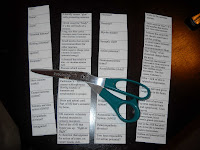
 r this jigsaw activity I invented. I start by creating a chart with 4 columns and 17 rows. In the first and 3rd columns I ask a question like Who was T. Jefferson? and in columns 2 and 4 I answer the question. It starts off looking like one of those review sheets we give our students before a big exam.
Then you must trim the edges and cut it into 4 columns (2 question columns and 2 answer columns).

Now cut the 2 answer columns into "confetti." Place 2 (uncut) question strips into envelope. Gather cut up answers and place into same envelope. Label envelope something like Chapter 2 or whatever.
For my class sizes, 12 envelopes is a good number. For me, it allows some students to pair up and others to get in groups of 3. Do not allow groups of 4. Have students match the answers to the questions. Make sure no student is reading upside down. Make sure all 3 students can read all of the answer choices. Unless you have a better idea, walk around the room and check each group's work and make them fix the ones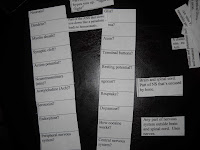 they got wrong. Have the students do it again once they are finished.
The beauty of the jigsaw is you can review many vocabulary terms in one class period.
Tips: 1.Remind the students to check their laps and the floor at the end of the exercise. 2.At the beginning, remind them to completely empty the envelope.
3.Before you cut the paper up with scissors, color the back of each paper with a map pencil. The reason for this is you will find a stray answer on the ground and you will want to know which envelope it belongs in.
I have done this for years. I have rarely been able to use a jigsaw for 2 consecutive years because answers always get lost.
For my class sizes, 12 envelopes is a good number. For me, it allows some students to pair up and others to get in groups of 3. Do not allow groups of 4. Have students match the answers to the questions. Make sure no student is reading upside down. Make sure all 3 students can read all of the answer choices. Unless you have a better idea, walk around the room and check each group's work and make them fix the ones
 they got wrong. Have the students do it again once they are finished.
The beauty of the jigsaw is you can review many vocabulary terms in one class period.
Tips: 1.Remind the students to check their laps and the floor at the end of the exercise. 2.At the beginning, remind them to completely empty the envelope.
3.Before you cut the paper up with scissors, color the back of each paper with a map pencil. The reason for this is you will find a stray answer on the ground and you will want to know which envelope it belongs in.
I have done this for years. I have rarely been able to use a jigsaw for 2 consecutive years because answers always get lost.
Friday, November 20, 2009
The Teenage Brain

Even good students are tired and not as motivated as we teachers would like them to be. Some of that is due to being a teenager. It turns out that, in teens, there is an underdeveloped part of the brain called the nucleus accumens that is related to our pleasure-seeking centers of our brain. What that means is teens are not as easily impressed by things as are adults. The reason many teens do drugs and engage in dangerous activities is that only extremes can give them any kind of thrill. I'm an adult, and I get a thrill out of Starbucks, hammocks and reading non-fiction books, so my nucleus accumens does not need as much stimulation as my students'. This information is virtually useless to you as a teacher, but it is nice to know why teens act the way they do. It explains why something obviously interesting is not that interesting to them.
Another part of the brain you should know about is the amygdala. This is your panic button or excitement button. It tells your body to produce norepinephrine (adrenaline). When I go to boring teacher meetings and I remember boring college professors, I think about things that I can do as a teacher to get students' amygdalas to fire. I thought why can't I try to run a classroom like a sales presentation. I start out by playing loud, abnoxious music. Then I say, "Hello, class." I say it loudly like a Southern preacher. These things activate the students' amygdalas and get their adrenaline going. Getting them to laugh is a big deal, also. My old principal was a math teacher and he spent the first few minutes of every day telling jokes. I often play silly videos that I save from youtube that get a laugh. The videos are sometimes less than a minute and I play them before the tardy bell rings so not much time is wasted. I regularly will clap my hands loudly like a coach say c'mon c'mon let's do it! Energy is the key!
Wednesday, November 18, 2009
Dealing with Student Talking

It is not a given that students like nice teachers. Students like my teaching, for example, but "nice" is not the first word they use to describe me. What do students like in a teacher? Well, consider these quotes from students describing what they don't like: Man, I don't like that class; he doesn't teach us anything! Man, we never do anything in that class. She can't control her class. All he ever does is yell. She has her favorites in that class. My approach to classroom management is similar to taking them on a journey. However, this is a journey of reluctant learners. You are expected to teach a class of 35 students who are forced by law to be in school. Leading these 35 horses to water is not an easy task, even for experienced teachers. Here are some strategies that I use almost every day to keep talking to a minimum.
Always say good morning or hello to your class.
I do this 6 times every day for 187 days. It sets a positive tone in the classroom. However, it has an ulterior purpose: It means now is the time to stop talking and pay attention to what I am saying. It is important that your students return the gesture and stop talking. If they don't, say it louder and more assertively again and again until you have a quiet room ready to hear what you have to say. Saying good morning really loud and obnoxiously will also help wake your first period from their slumber. Remember! Being a cheerleader for your class is part of the job.
Dealing with Side Conversations
It is human nature to try to have a side conversation with a fellow student during a lesson. Even we teachers do it when we aren't supposed to. However, 33 of your students are watching you to see how you address the 2 people conversing about a fight they saw earlier. If you, the teacher, feel that the time is inappropriate, then you must address it. Don't let it carry on because it will get worse, and the entire class will not like your class because you let them do what they want. Students do prefer teachers who maintain discipline, just like you do in your staff meetings. My approach to side conversations has 3 components: 1. Almost zero tolerance; 2. the behavior must be addressed so it doesn't spread like a disease; 3. it must be addressed quickly in order to maintain the flow of the lesson; 4. (optional) it must be done in a non-personal way.
Here are some things I do to deal with talking: I try to never address the behavior or the student directly. I speak with a commanding voice (much like a football coach), and if necessary I will repeat a short phrase over and over and over again until I have everyone's attention. Sometimes, I'll make a loud EEEh sound that overpowers side conversations. It's really annoying, somewhat funny to the class and very effective at ending their conversation quickly. Calling on the student is helpful in ending his or her conversation if used only on occasion. The reason I try not to address the talking directly is because I prefer to use hand signals and dirty looks over stopping the flow of the class. About twice per day I do have to firmly yell to get the entire class to stop talking and pay attention, but once I have that I try to use more subtle approaches. Other options include telling them to stop talking in a firm voice or changing their seating arrangement.
Seating Arrangement
Students will talk. Some will naturally talk more than others. Have a seating arrangement that will make it easy on you to monitor it. Seating talkative students near you will keep you from having to run across the room several times. Keeping talkative students away from the door is a good idea since they will shout as students walk by. Be careful about seating talkative students with each other, but sometimes it's better to have 2 talkative students close to you than to have them shouting across the room. My preferred classroom arrangement is having my "desk" in the center of the room so I can be within arm's length of half the class. However, it's tough being a floater!
Positive Talking
Do you really want a quiet classroom? I don't. Let the jokester make an occasional joke to the class, not to his/her buddies. Sometimes they will make a personal dig at you. Sometimes it's best to let it go because if you can't take a "dig" they will see you as weak and get a kick out of messing with you. Try to take their jokes in stride if their intention is to test your sense of humor. But never tolerate a heckler who is trying to disrupt class for their own gain in social status. Deal with him/her and get back to teaching.
Remember, this job isn't easy. Do the best you can without relying too much on security and administration. (Students notice that!) Observe how different teachers begin the class and have them observe you as well. Good luck.
Thursday, August 27, 2009
Fires in the Bathroom

Fires in the Bathroom illustrates the high school classroom from the students' perspective. It is full of quotes by high school students with a variety of backgrounds. Many of the quotes had an "urban" dialect which gave them authenticity, to me at least. Of course, students aren't always practical or rational, but I think the editor chose the quotes well to convey the points.
I liked that the book was about high school. I'm sick of having Harry Wong and other non-high school teachers telling me how to run my classroom. It is not the same. It's only the same if you have an idea and you want ME to buy your book and my principal to pay for your conference.
The book isn't perfect, but until I have the nerve to survey my own students, I'm going to reccommend this book.
Monday, April 27, 2009
Do we have different learning styles?

I just read a WSJ review of a book. The book is called Why Don't Students Like School? by Daniel Willingham. Click here for the review. I've seen books written for teachers by psychology professors. I've read one called Secrets of the Teenage Brain. As a Psychology teacher, I really enjoyed it. It discusses how to maximize teaching and learning by employing what scientists know about how our brain works. In other words, the book explains some of the brain-based methods of teaching. Anyway, Willingham's book seems to debate the existence of learning styles. He is apparently a big fan of traditional teaching methods such as making kids memorize stuff instead of having them employ higher-level thinking all of the time and having kinesthetic learners use their hands.
Here is my philosophy: Memorization is good. Doctors need to memorize the parts of the heart and the brain. History students need to know certain dates and dead White guys. Also, teaching the same material in a different way is good. Variety is good for the sake of variety. If you want to drill and kill, then that's fine. However, please don't bore your students into submission by doing the same thing all of the time. I'm certain that if they first read Chapter 5 then are shown Chapter 5 (via Power Point) and given a fun review (like Jeopardy) then that's a good varied way of teaching the material.
Whether we have "learning styles" is an important question for academics, but in reality we should all teach in a varied and interesting manner. You don't need to have a learning style to appreciate good teaching. Do what I try to do: Teach to the mind; teach to the eyes; teach to the hands; teach to the heart.
Tuesday, February 17, 2009
Dealing With Your Most "Challenging" Students

Let's be clear: Having enthusiastic, bell-to-bell instruction will reduce discipline problems in a major way. But what if you haven't achieved that and you have a couple of students in each class that refuse to do anything? You need all the advice you can get to deal with these students. I'll do what I can here:
Let's start with some ways to keep the entire class on task: First, you need to walk around the room. If you sit at your desk or your computer, you will have 5 or more students not doing anything. Many of them will eventually copy off of someone else. Walk around!
Second, instead of griping, try a positive approach. Walk over to them and ask them if they need help. Address them individually, not as a group. (This is why you need a seating chart and to know their names!) Hector, do you need help? Many times they will say no and start working. Sometimes they will take you up on your offer and ask for help. Do not expect students to ask for help if they need it. Luckily, most of the time, they are just spacing out and just need a little encouragement to get to work. Be persistent! My students know that when I ask them if they need help that I have a double meaning. I'm genuinely wanting to help them if they want it; I'm telling them to get their rear in gear!
Third, there is the therapeutic approach. Subtly call them in the hall and ask them what's going on. Tell them that you've already asked them if they needed help several times yet they still aren't getting their work done. They might tell you that they are working nights or something. This approach might make you seem more human and they might respond. But in the end, it doesn't matter what is going on. They HAVE TO DO THEIR WORK!
Fourth, call home. this won't take up too much time since most of their numbers are disconnected or incorrect. You might ask them for their parent's phone number. Tell them that you have already tried to talk to them like an adult and it didn't work so you will go to their parents. If they are athletic, tell their coach.
There is one more optional step before getting the principals involved. I call it the beating your chest approach. Different students respond differently to this approach, but sometimes you just gotta yell and scream like an animal establishing dominance. It may not work with that one student, but in many cases, that one student is a leader of a pack and that pack will stop working if their leader does. You are the leader of the pack, not him.
If you do get the principal involved, remember that they will talk to them and possibly their parents. But other than that, the only thing they can do is suspend them in school or out of school. They aren't going to learn that way, but at least you made an important statement to the rest of the class.
Again, let's try not to get to these last 2 steps. Let's try to be fun and as positive as we can while we are teaching these kids. Unfortunately, we have to be a bad guy on occasion to achieve this positive environment in the long run.
All of the above only deals with students who refuse to work. If they are disruptive, meaning they shout or throw things or cuss you out, then you have to skip several steps. You might have to call someone to remove them from your room immediately. Do not let anything or anyone stop the learning in your classroom.
Wednesday, December 17, 2008
Raising your passing rates

In my first year of teaching, our principal would plead with the teachers to raise their passing rates. I, like many new teachers, had a traditional approach to education: give the assignment; then give a zero if they don't do the work. My failure rates approached 25% at times, and the principal would have a conference with me to discuss what I was doing to lower my failure rates. Eventually I succeeded. Here is what I did/do.
1. I walk around and make sure everyone is doing what they are supposed to be doing. From a distance, I can see which students have a pencil in their hand and which students are looking at what they are supposed to be doing. Watch their eyes! Watch their hands! Basically, do not let them decide whether or not they do the assignment. Goal: Everyone does the assignment every day. So for the most part, everyone gets a 100 every day whether they like it or not.
2. Now that I know they are doing their work, I often times give everyone a 100 if they were present and a zero if they weren't. When a student returns the next day, I will give them the assignment or some extra credit. This makes it easy on you, as well. At the beginning of the year, grade everything so students don't catch on.
3. Call home if a student isn't showing up to class. Parents need to know.
4. Make sure students don't copy off of other students. If they do, they will fail their finals and make you look bad.
5. Make sure your assignments are meaningful. Working out of a textbook in many classes doesn't work because textbook companies don't make good questions. All students do is skim like it's a scavenger hunt. They learn almost nothing. If you use a textbook, design the questions to what you want them to learn. Design the assignments yourself so you can cater them to your testing standards.
6. Tell the students about every other week what assignments they need to turn in. They will not come to you the day after they are absent to ask you what they missed. Unfortunately, you will have to seek them out and tell them what they need to do. I don't reccommend giving them their average if they are passing. If they have an 85 average and you tell them, they won't do anything to make it up.
7. Have a make up day on the last day of the grading period for them to do an assignment that they failed to do. This really helps.
8. I don't take off for late work. As long as I know that they did it themselves, I will give them full credit. After all, if the assignment was meaningful, then it was worth doing. If they did it and learned, they deserve full credit. If you take off too many points for late work, the student may not do it at all. They will learn more if they do the assignment than if they don't do the assignment. Plain and simple.
9. Consider not assigning homework. If you don't teach AP and you don't teach math, then you are setting them up to fail. They won't do it. If you have a way of getting inner city kids to do homework in a non-AP class then please comment.
In a non-advanced classroom, the only kids failing should be the few that don't show up at all. In most cases, if a kid shows up almost every day, they should be passing.
Tuesday, November 18, 2008
Getting girls to participate
In my experience, when I call on a girl to answer a question, there is a higher chance that a boy will blurt out the answer when the girl does not answer immediately. Also, in my experience, when we read aloud, boys heckle the girls at a greater rate than boys heckling other boys. There is no easy solution to this but I have had some success in equalizing participation.
In the beginning of the year, when I ask a girl to answer a question and a boy shouts out the answer, I make it clear that a: I appreciate it when students participate in class. b: when I call on a student I expect that student to have a chance to answer the question and not be rescued by a boy. There have been times when I call a boy into the hall and have a quick talk with him (about 1 or 2 sentences). The boys don't mean any harm; it's basically a mating ritual like throwing paper balls at them. Just be aware that it is going on and try to put a stop to it. I certainly protect my girls, but it's just one issue among a million to deal with.
In the beginning of the year, when I ask a girl to answer a question and a boy shouts out the answer, I make it clear that a: I appreciate it when students participate in class. b: when I call on a student I expect that student to have a chance to answer the question and not be rescued by a boy. There have been times when I call a boy into the hall and have a quick talk with him (about 1 or 2 sentences). The boys don't mean any harm; it's basically a mating ritual like throwing paper balls at them. Just be aware that it is going on and try to put a stop to it. I certainly protect my girls, but it's just one issue among a million to deal with.
Friday, October 31, 2008
You Don't REALLY Need to Go Do YOU?

Effective classroom management is always a balance between being a decent human being and a strict disciplinarian. Teachers often let too many students leave to go to the bathroom. Let me give you a few tips on reducing your bathroom trips.
First, imagine you are a student. If you have a choice to walk your girlfriend to class or to relieve yourself, what would you choose? Students keep a mental list of which teachers are "cool" and which ones you don't even bother to ask for a pass. Don't be the latter!
When a student asks you to go to the bathroom, say, "Hold that thought" and continue what you were doing. Many times the student won't ask you again. When they do, you might repeat the first step and put them off. If you can manage to put them off long enough then you can say, "Well, it's almost time to go!"
When you, on occasion, let them go, don't make it pleasant for them. Give them a dirty look. Take a deep breath to show you are slightly annoyed at them. Tell them, "Okay, but hurry. Don't make a habit of this!" Students are constantly trying to gage which teachers are cool with bathroom breaks and which ones aren't. From a psychological perspective, don't reward them with smile and an easy-going attitude. Make 'em pay!
When a student asks you loudly in front of the class if they can go, the answer is always, "No." If they ask you privately, then give them an annoying look or other posture and let them go. If your class sees you letting one student go, then you will have literally 4 or 5 saying, "Can I go, too?" Those students didn't need to go bad enough to ask themselves, but all the sudden they all have an "emergency." Don't let this happen. Make them ask you privately to avoid this line.
Keep them busy! Bell to bell business always distracts them from their bladders. Honestly, students just like to walk around. They genuinely need to go, but they really want a change of pace/scenery. You can't blame them, but you can't have 4 people per hour roaming the halls causing problems for other teachers. It seems that when I'm teaching, students rarely need to go. However, when I transition between one activity to another, someone always asks. Keep 'em busy!
Some of you will just say no all the time. That is a great approach as long as you are human about it.
Monday, October 20, 2008
Watch their eyes!

Where are your studens looking? Are they looking at what you are trying to show them? Are they looking at the book? A quick glance around the room can be a handy strategy of detecting off-task behavior. If you are showing a power point or a movie or a math problem and your student is looking down near their belt buckle area then they are probably on the phone. They could also be fascinated with various objects. Kids get fascinated with all sorts of objects. I'll show a $20 million dollar movie with lots of special effects and violence and I still find students staring at their erasers or bottle caps. Teen behavior is really fascinating, isn't it?
Again, watch their hands; watch their eyes. Don't let them get behind because once they do, they'll copy off of somebody or simply give up. Don't let them get behind. Don't let them think they can get away with it!
Subscribe to:
Posts (Atom)