Friday, May 7, 2010

Great jigsaw actiivty!!

If you teach a class where there are many vocabulary words to memorize, then consider this jigsaw activity I invented. I start by creating a chart with 4 columns and 17 rows. In the first and 3rd columns I ask a question like Who was T. Jefferson? and in columns 2 and 4 I answer the question. It starts off looking like one of those review sheets we give our students before a big exam.


Then you must trim the edges and cut it into 4 columns (2 question columns and 2 answer columns).
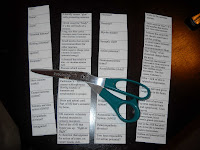


Now cut the 2 answer columns into "confetti." Place 2 (uncut) question strips into envelope. Gather cut up answers and place into same envelope. Label envelope something like Chapter 2 or whatever.

For my class sizes, 12 envelopes is a good number. For me, it allows some students to pair up and others to get in groups of 3. Do not allow groups of 4. Have students match the answers to the questions. Make sure no student is reading upside down. Make sure all 3 students can read all of the answer choices. Unless you have a better idea, walk around the room and check each group's work and make them fix the ones they got wrong. Have the students do it again once they are finished.
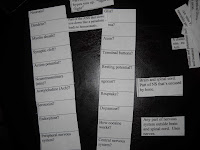
The beauty of the jigsaw is you can review many vocabulary terms in one class period.

Tips: 1.Remind the students to check their laps and the floor at the end of the exercise. 2.At the beginning, remind them to completely empty the envelope.
3.Before you cut the paper up with scissors, color the back of each paper with a map pencil. The reason for this is you will find a stray answer on the ground and you will want to know which envelope it belongs in.

I have done this for years. I have rarely been able to use a jigsaw for 2 consecutive years because answers always get lost.

Friday, November 20, 2009

The Teenage Brain


Even good students are tired and not as motivated as we teachers would like them to be. Some of that is due to being a teenager. It turns out that, in teens, there is an underdeveloped part of the brain called the nucleus accumens that is related to our pleasure-seeking centers of our brain. What that means is teens are not as easily impressed by things as are adults. The reason many teens do drugs and engage in dangerous activities is that only extremes can give them any kind of thrill. I'm an adult, and I get a thrill out of Starbucks, hammocks and reading non-fiction books, so my nucleus accumens does not need as much stimulation as my students'. This information is virtually useless to you as a teacher, but it is nice to know why teens act the way they do. It explains why something obviously interesting is not that interesting to them.

Another part of the brain you should know about is the amygdala. This is your panic button or excitement button. It tells your body to produce norepinephrine (adrenaline). When I go to boring teacher meetings and I remember boring college professors, I think about things that I can do as a teacher to get students' amygdalas to fire. I thought why can't I try to run a classroom like a sales presentation. I start out by playing loud, abnoxious music. Then I say, "Hello, class." I say it loudly like a Southern preacher. These things activate the students' amygdalas and get their adrenaline going. Getting them to laugh is a big deal, also. My old principal was a math teacher and he spent the first few minutes of every day telling jokes. I often play silly videos that I save from youtube that get a laugh. The videos are sometimes less than a minute and I play them before the tardy bell rings so not much time is wasted. I regularly will clap my hands loudly like a coach say c'mon c'mon let's do it! Energy is the key!

Wednesday, November 18, 2009

Dealing with Student Talking


It is not a given that students like nice teachers. Students like my teaching, for example, but "nice" is not the first word they use to describe me. What do students like in a teacher? Well, consider these quotes from students describing what they don't like: Man, I don't like that class; he doesn't teach us anything! Man, we never do anything in that class. She can't control her class. All he ever does is yell. She has her favorites in that class. My approach to classroom management is similar to taking them on a journey. However, this is a journey of reluctant learners. You are expected to teach a class of 35 students who are forced by law to be in school. Leading these 35 horses to water is not an easy task, even for experienced teachers. Here are some strategies that I use almost every day to keep talking to a minimum.

Always say good morning or hello to your class.
I do this 6 times every day for 187 days. It sets a positive tone in the classroom. However, it has an ulterior purpose: It means now is the time to stop talking and pay attention to what I am saying. It is important that your students return the gesture and stop talking. If they don't, say it louder and more assertively again and again until you have a quiet room ready to hear what you have to say. Saying good morning really loud and obnoxiously will also help wake your first period from their slumber. Remember! Being a cheerleader for your class is part of the job.

Dealing with Side Conversations
It is human nature to try to have a side conversation with a fellow student during a lesson. Even we teachers do it when we aren't supposed to. However, 33 of your students are watching you to see how you address the 2 people conversing about a fight they saw earlier. If you, the teacher, feel that the time is inappropriate, then you must address it. Don't let it carry on because it will get worse, and the entire class will not like your class because you let them do what they want. Students do prefer teachers who maintain discipline, just like you do in your staff meetings. My approach to side conversations has 3 components: 1. Almost zero tolerance; 2. the behavior must be addressed so it doesn't spread like a disease; 3. it must be addressed quickly in order to maintain the flow of the lesson; 4. (optional) it must be done in a non-personal way.
Here are some things I do to deal with talking: I try to never address the behavior or the student directly. I speak with a commanding voice (much like a football coach), and if necessary I will repeat a short phrase over and over and over again until I have everyone's attention. Sometimes, I'll make a loud EEEh sound that overpowers side conversations. It's really annoying, somewhat funny to the class and very effective at ending their conversation quickly. Calling on the student is helpful in ending his or her conversation if used only on occasion. The reason I try not to address the talking directly is because I prefer to use hand signals and dirty looks over stopping the flow of the class. About twice per day I do have to firmly yell to get the entire class to stop talking and pay attention, but once I have that I try to use more subtle approaches. Other options include telling them to stop talking in a firm voice or changing their seating arrangement.

Seating Arrangement
Students will talk. Some will naturally talk more than others. Have a seating arrangement that will make it easy on you to monitor it. Seating talkative students near you will keep you from having to run across the room several times. Keeping talkative students away from the door is a good idea since they will shout as students walk by. Be careful about seating talkative students with each other, but sometimes it's better to have 2 talkative students close to you than to have them shouting across the room. My preferred classroom arrangement is having my "desk" in the center of the room so I can be within arm's length of half the class. However, it's tough being a floater!

Positive Talking
Do you really want a quiet classroom? I don't. Let the jokester make an occasional joke to the class, not to his/her buddies. Sometimes they will make a personal dig at you. Sometimes it's best to let it go because if you can't take a "dig" they will see you as weak and get a kick out of messing with you. Try to take their jokes in stride if their intention is to test your sense of humor. But never tolerate a heckler who is trying to disrupt class for their own gain in social status. Deal with him/her and get back to teaching.

Remember, this job isn't easy. Do the best you can without relying too much on security and administration. (Students notice that!) Observe how different teachers begin the class and have them observe you as well. Good luck.

Thursday, August 27, 2009

Fires in the Bathroom


Fires in the Bathroom illustrates the high school classroom from the students' perspective. It is full of quotes by high school students with a variety of backgrounds. Many of the quotes had an "urban" dialect which gave them authenticity, to me at least. Of course, students aren't always practical or rational, but I think the editor chose the quotes well to convey the points.

I liked that the book was about high school. I'm sick of having Harry Wong and other non-high school teachers telling me how to run my classroom. It is not the same. It's only the same if you have an idea and you want ME to buy your book and my principal to pay for your conference.

The book isn't perfect, but until I have the nerve to survey my own students, I'm going to reccommend this book.

Monday, April 27, 2009

Do we have different learning styles?


I just read a WSJ review of a book. The book is called Why Don't Students Like School? by Daniel Willingham. Click here for the review. I've seen books written for teachers by psychology professors. I've read one called Secrets of the Teenage Brain. As a Psychology teacher, I really enjoyed it. It discusses how to maximize teaching and learning by employing what scientists know about how our brain works. In other words, the book explains some of the brain-based methods of teaching. Anyway, Willingham's book seems to debate the existence of learning styles. He is apparently a big fan of traditional teaching methods such as making kids memorize stuff instead of having them employ higher-level thinking all of the time and having kinesthetic learners use their hands.

Here is my philosophy: Memorization is good. Doctors need to memorize the parts of the heart and the brain. History students need to know certain dates and dead White guys. Also, teaching the same material in a different way is good. Variety is good for the sake of variety. If you want to drill and kill, then that's fine. However, please don't bore your students into submission by doing the same thing all of the time. I'm certain that if they first read Chapter 5 then are shown Chapter 5 (via Power Point) and given a fun review (like Jeopardy) then that's a good varied way of teaching the material.

Whether we have "learning styles" is an important question for academics, but in reality we should all teach in a varied and interesting manner. You don't need to have a learning style to appreciate good teaching. Do what I try to do: Teach to the mind; teach to the eyes; teach to the hands; teach to the heart.

Tuesday, February 17, 2009

Dealing With Your Most "Challenging" Students


Let's be clear: Having enthusiastic, bell-to-bell instruction will reduce discipline problems in a major way. But what if you haven't achieved that and you have a couple of students in each class that refuse to do anything? You need all the advice you can get to deal with these students. I'll do what I can here:

Let's start with some ways to keep the entire class on task: First, you need to walk around the room. If you sit at your desk or your computer, you will have 5 or more students not doing anything. Many of them will eventually copy off of someone else. Walk around!

Second, instead of griping, try a positive approach. Walk over to them and ask them if they need help. Address them individually, not as a group. (This is why you need a seating chart and to know their names!) Hector, do you need help? Many times they will say no and start working. Sometimes they will take you up on your offer and ask for help. Do not expect students to ask for help if they need it. Luckily, most of the time, they are just spacing out and just need a little encouragement to get to work. Be persistent! My students know that when I ask them if they need help that I have a double meaning. I'm genuinely wanting to help them if they want it; I'm telling them to get their rear in gear!

Third, there is the therapeutic approach. Subtly call them in the hall and ask them what's going on. Tell them that you've already asked them if they needed help several times yet they still aren't getting their work done. They might tell you that they are working nights or something. This approach might make you seem more human and they might respond. But in the end, it doesn't matter what is going on. They HAVE TO DO THEIR WORK!

Fourth, call home. this won't take up too much time since most of their numbers are disconnected or incorrect. You might ask them for their parent's phone number. Tell them that you have already tried to talk to them like an adult and it didn't work so you will go to their parents. If they are athletic, tell their coach.

There is one more optional step before getting the principals involved. I call it the beating your chest approach. Different students respond differently to this approach, but sometimes you just gotta yell and scream like an animal establishing dominance. It may not work with that one student, but in many cases, that one student is a leader of a pack and that pack will stop working if their leader does. You are the leader of the pack, not him.

If you do get the principal involved, remember that they will talk to them and possibly their parents. But other than that, the only thing they can do is suspend them in school or out of school. They aren't going to learn that way, but at least you made an important statement to the rest of the class.

Again, let's try not to get to these last 2 steps. Let's try to be fun and as positive as we can while we are teaching these kids. Unfortunately, we have to be a bad guy on occasion to achieve this positive environment in the long run.

All of the above only deals with students who refuse to work. If they are disruptive, meaning they shout or throw things or cuss you out, then you have to skip several steps. You might have to call someone to remove them from your room immediately. Do not let anything or anyone stop the learning in your classroom.

Wednesday, December 17, 2008

Raising your passing rates


In my first year of teaching, our principal would plead with the teachers to raise their passing rates. I, like many new teachers, had a traditional approach to education: give the assignment; then give a zero if they don't do the work. My failure rates approached 25% at times, and the principal would have a conference with me to discuss what I was doing to lower my failure rates. Eventually I succeeded. Here is what I did/do.

1. I walk around and make sure everyone is doing what they are supposed to be doing. From a distance, I can see which students have a pencil in their hand and which students are looking at what they are supposed to be doing. Watch their eyes! Watch their hands! Basically, do not let them decide whether or not they do the assignment. Goal: Everyone does the assignment every day. So for the most part, everyone gets a 100 every day whether they like it or not.

2. Now that I know they are doing their work, I often times give everyone a 100 if they were present and a zero if they weren't. When a student returns the next day, I will give them the assignment or some extra credit. This makes it easy on you, as well. At the beginning of the year, grade everything so students don't catch on.

3. Call home if a student isn't showing up to class. Parents need to know.

4. Make sure students don't copy off of other students. If they do, they will fail their finals and make you look bad.

5. Make sure your assignments are meaningful. Working out of a textbook in many classes doesn't work because textbook companies don't make good questions. All students do is skim like it's a scavenger hunt. They learn almost nothing. If you use a textbook, design the questions to what you want them to learn. Design the assignments yourself so you can cater them to your testing standards.

6. Tell the students about every other week what assignments they need to turn in. They will not come to you the day after they are absent to ask you what they missed. Unfortunately, you will have to seek them out and tell them what they need to do. I don't reccommend giving them their average if they are passing. If they have an 85 average and you tell them, they won't do anything to make it up.

7. Have a make up day on the last day of the grading period for them to do an assignment that they failed to do. This really helps.

8. I don't take off for late work. As long as I know that they did it themselves, I will give them full credit. After all, if the assignment was meaningful, then it was worth doing. If they did it and learned, they deserve full credit. If you take off too many points for late work, the student may not do it at all. They will learn more if they do the assignment than if they don't do the assignment. Plain and simple.

9. Consider not assigning homework. If you don't teach AP and you don't teach math, then you are setting them up to fail. They won't do it. If you have a way of getting inner city kids to do homework in a non-AP class then please comment.

In a non-advanced classroom, the only kids failing should be the few that don't show up at all. In most cases, if a kid shows up almost every day, they should be passing.