Saturday, November 5, 2011
Adding Multiple Choice Questions to Moodle
It's very challenging to get students to do large numbers of muliple choice questions as homework without having them cheat. Well, soon I'll have almost 100 questions per chapter and Moodle will randomize the questions and randomize the answers! It will be very challenging for students to simply write down the answers or the first few words of the answers for that many questions. So, I'm looking forward to seeing how it works in the real classroom.
If you use Examview, you can import your tests into Moodle. I could sit here and explain it but here is a video that says exactly how to do it. One thing the video didn't mention is you need to use Examview 6. If you use an older or a newer version I can't promise you anything. I tried using Examview 3.5 and it did NOT work. All I can tell you is I did exactly what the video said with Examview 6 and it is working for me.


Wednesday, February 2, 2011
Reducing paper and your trouble
 I don't make an excessive amount of copies, but I do like to project stuff on the screen at times and save a trip to the copy room. This year I found a way to reduce that.
Let's say you have a website that has multiple choice tests on it but the kids can't read them when projected on the big screen. For years I've dealt with this problem. Printing the website isn't always ideal since it never looks quite right with all the ads and links at the bottom. I like to go to www.quizlet.com and I like to go to www.appsychology.com and practice multiple choice tests and other activities with my students. Here's the trick: Go to the website and click on View. Then click on Zoom. You will have choices to choose from. Somewhere around 180% always works for me. Students in the back say they can see the board just fine. To make sure, ask them to read something so they can't lie to you.
This idea also works with Microsoft Word. Sure, I've played with font sizes for years and it didn't work. Try playing with the zoom level and the view level. Under view, you can choose between viewing the document as a web layout, normal, or print layout. Just try it. I just started using Office 2007, so I'm not exactly sure how to do it but it's worth playing around with it when you want to display a word document to the class.
If you teach Psychology, imagine using this webpage in class:
http://appsychology.com/HowPass/MC%20quizes/Intelligence/intelligence.htm
Also, if you teach anything where you need to memorize stuff, try quizlet. Here is a game on quizlet where the teacher types in words and definitions and the student plays a game:
Go to this link and click on scatter.
http://quizlet.com/730039/research-flash-cards/
Sunday, January 30, 2011
Wednesday, November 17, 2010
When To Outsource Your Problems???
New teachers in rough schools always get the advice to not write principal referrals. The advice is well-meaning but new teachers commonly misconstrue the advice. Many new teachers just elect to NEVER write referrals. Some teachers, even veterans, write too many. Principals don't want to tell when exactly to write them because they fear we will write even more! This post is my best attempt to tell you when it is appropriate to refer your students to the principal. This is based only on my experience with 2 schools in my school district.
Breaking the law: If a student skips your class or leaves your class, call the parent and on the second infraction write the referral. This also applies to verbal assault. If a student says %$@# you, then write it up. However, in this district, we tolerate %$#@ this, man! Obviously, if they threaten harm to you or fight then you need to write one.
Disrespect to school personnel: If a student is in defiance of your authority and you might want to write a referral, especially if it is ruining his/her education or that of the rest of the class. If a student refuses to do their work in your class, call the parent, tell his or her coach, have a hallway conference, tell his/her counselor, document ALL of that and THEN write a referral. No Child Left Behind means we cannot let a student sit there and fail. We have to make him/her do the work!
Good cop/Bad cop: Sometimes you get nasty in the room and you can't back down. Sometimes you need help; you need a principal or a counselor to talk to the student in a friendly, supporting demeanor that you simply don't have time to do during class. In cases like these, the principal will simply talk to them but not punish them in any way. Do not get mad at principals for doing this. You dealt with the problem and made an example of him. You won; move on!
When not to write a referral: Here are some quotes I've seen on referrals written over the years. Julio came in with a really bad attitude. She was disrespectful. He did not have a pencil or paper. She had an IPod in her pocket.
In summary, you write a referral to 1. make an example of someone with the intention of getting them in some kind of trouble. 2. to document an issue that could cause problems (like or refusal to do work).
Breaking the law: If a student skips your class or leaves your class, call the parent and on the second infraction write the referral. This also applies to verbal assault. If a student says %$@# you, then write it up. However, in this district, we tolerate %$#@ this, man! Obviously, if they threaten harm to you or fight then you need to write one.
Disrespect to school personnel: If a student is in defiance of your authority and you might want to write a referral, especially if it is ruining his/her education or that of the rest of the class. If a student refuses to do their work in your class, call the parent, tell his or her coach, have a hallway conference, tell his/her counselor, document ALL of that and THEN write a referral. No Child Left Behind means we cannot let a student sit there and fail. We have to make him/her do the work!
Good cop/Bad cop: Sometimes you get nasty in the room and you can't back down. Sometimes you need help; you need a principal or a counselor to talk to the student in a friendly, supporting demeanor that you simply don't have time to do during class. In cases like these, the principal will simply talk to them but not punish them in any way. Do not get mad at principals for doing this. You dealt with the problem and made an example of him. You won; move on!
When not to write a referral: Here are some quotes I've seen on referrals written over the years. Julio came in with a really bad attitude. She was disrespectful. He did not have a pencil or paper. She had an IPod in her pocket.
In summary, you write a referral to 1. make an example of someone with the intention of getting them in some kind of trouble. 2. to document an issue that could cause problems (like or refusal to do work).
Friday, May 7, 2010
Great jigsaw actiivty!!
If you teach a class where there are many vocabulary words to memorize, then conside r this jigsaw activity I invented. I start by creating a chart with 4 columns and 17 rows. In the first and 3rd columns I ask a question like Who was T. Jefferson? and in columns 2 and 4 I answer the question. It starts off looking like one of those review sheets we give our students before a big exam.
Then you must trim the edges and cut it into 4 columns (2 question columns and 2 answer columns).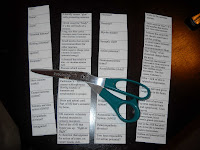
 r this jigsaw activity I invented. I start by creating a chart with 4 columns and 17 rows. In the first and 3rd columns I ask a question like Who was T. Jefferson? and in columns 2 and 4 I answer the question. It starts off looking like one of those review sheets we give our students before a big exam.
Then you must trim the edges and cut it into 4 columns (2 question columns and 2 answer columns).

Now cut the 2 answer columns into "confetti." Place 2 (uncut) question strips into envelope. Gather cut up answers and place into same envelope. Label envelope something like Chapter 2 or whatever.
For my class sizes, 12 envelopes is a good number. For me, it allows some students to pair up and others to get in groups of 3. Do not allow groups of 4. Have students match the answers to the questions. Make sure no student is reading upside down. Make sure all 3 students can read all of the answer choices. Unless you have a better idea, walk around the room and check each group's work and make them fix the ones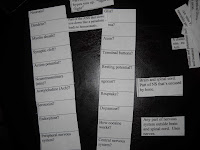 they got wrong. Have the students do it again once they are finished.
The beauty of the jigsaw is you can review many vocabulary terms in one class period.
Tips: 1.Remind the students to check their laps and the floor at the end of the exercise. 2.At the beginning, remind them to completely empty the envelope.
3.Before you cut the paper up with scissors, color the back of each paper with a map pencil. The reason for this is you will find a stray answer on the ground and you will want to know which envelope it belongs in.
I have done this for years. I have rarely been able to use a jigsaw for 2 consecutive years because answers always get lost.
For my class sizes, 12 envelopes is a good number. For me, it allows some students to pair up and others to get in groups of 3. Do not allow groups of 4. Have students match the answers to the questions. Make sure no student is reading upside down. Make sure all 3 students can read all of the answer choices. Unless you have a better idea, walk around the room and check each group's work and make them fix the ones
 they got wrong. Have the students do it again once they are finished.
The beauty of the jigsaw is you can review many vocabulary terms in one class period.
Tips: 1.Remind the students to check their laps and the floor at the end of the exercise. 2.At the beginning, remind them to completely empty the envelope.
3.Before you cut the paper up with scissors, color the back of each paper with a map pencil. The reason for this is you will find a stray answer on the ground and you will want to know which envelope it belongs in.
I have done this for years. I have rarely been able to use a jigsaw for 2 consecutive years because answers always get lost.
Friday, November 20, 2009
The Teenage Brain

Even good students are tired and not as motivated as we teachers would like them to be. Some of that is due to being a teenager. It turns out that, in teens, there is an underdeveloped part of the brain called the nucleus accumens that is related to our pleasure-seeking centers of our brain. What that means is teens are not as easily impressed by things as are adults. The reason many teens do drugs and engage in dangerous activities is that only extremes can give them any kind of thrill. I'm an adult, and I get a thrill out of Starbucks, hammocks and reading non-fiction books, so my nucleus accumens does not need as much stimulation as my students'. This information is virtually useless to you as a teacher, but it is nice to know why teens act the way they do. It explains why something obviously interesting is not that interesting to them.
Another part of the brain you should know about is the amygdala. This is your panic button or excitement button. It tells your body to produce norepinephrine (adrenaline). When I go to boring teacher meetings and I remember boring college professors, I think about things that I can do as a teacher to get students' amygdalas to fire. I thought why can't I try to run a classroom like a sales presentation. I start out by playing loud, abnoxious music. Then I say, "Hello, class." I say it loudly like a Southern preacher. These things activate the students' amygdalas and get their adrenaline going. Getting them to laugh is a big deal, also. My old principal was a math teacher and he spent the first few minutes of every day telling jokes. I often play silly videos that I save from youtube that get a laugh. The videos are sometimes less than a minute and I play them before the tardy bell rings so not much time is wasted. I regularly will clap my hands loudly like a coach say c'mon c'mon let's do it! Energy is the key!
Wednesday, November 18, 2009
Dealing with Student Talking

It is not a given that students like nice teachers. Students like my teaching, for example, but "nice" is not the first word they use to describe me. What do students like in a teacher? Well, consider these quotes from students describing what they don't like: Man, I don't like that class; he doesn't teach us anything! Man, we never do anything in that class. She can't control her class. All he ever does is yell. She has her favorites in that class. My approach to classroom management is similar to taking them on a journey. However, this is a journey of reluctant learners. You are expected to teach a class of 35 students who are forced by law to be in school. Leading these 35 horses to water is not an easy task, even for experienced teachers. Here are some strategies that I use almost every day to keep talking to a minimum.
Always say good morning or hello to your class.
I do this 6 times every day for 187 days. It sets a positive tone in the classroom. However, it has an ulterior purpose: It means now is the time to stop talking and pay attention to what I am saying. It is important that your students return the gesture and stop talking. If they don't, say it louder and more assertively again and again until you have a quiet room ready to hear what you have to say. Saying good morning really loud and obnoxiously will also help wake your first period from their slumber. Remember! Being a cheerleader for your class is part of the job.
Dealing with Side Conversations
It is human nature to try to have a side conversation with a fellow student during a lesson. Even we teachers do it when we aren't supposed to. However, 33 of your students are watching you to see how you address the 2 people conversing about a fight they saw earlier. If you, the teacher, feel that the time is inappropriate, then you must address it. Don't let it carry on because it will get worse, and the entire class will not like your class because you let them do what they want. Students do prefer teachers who maintain discipline, just like you do in your staff meetings. My approach to side conversations has 3 components: 1. Almost zero tolerance; 2. the behavior must be addressed so it doesn't spread like a disease; 3. it must be addressed quickly in order to maintain the flow of the lesson; 4. (optional) it must be done in a non-personal way.
Here are some things I do to deal with talking: I try to never address the behavior or the student directly. I speak with a commanding voice (much like a football coach), and if necessary I will repeat a short phrase over and over and over again until I have everyone's attention. Sometimes, I'll make a loud EEEh sound that overpowers side conversations. It's really annoying, somewhat funny to the class and very effective at ending their conversation quickly. Calling on the student is helpful in ending his or her conversation if used only on occasion. The reason I try not to address the talking directly is because I prefer to use hand signals and dirty looks over stopping the flow of the class. About twice per day I do have to firmly yell to get the entire class to stop talking and pay attention, but once I have that I try to use more subtle approaches. Other options include telling them to stop talking in a firm voice or changing their seating arrangement.
Seating Arrangement
Students will talk. Some will naturally talk more than others. Have a seating arrangement that will make it easy on you to monitor it. Seating talkative students near you will keep you from having to run across the room several times. Keeping talkative students away from the door is a good idea since they will shout as students walk by. Be careful about seating talkative students with each other, but sometimes it's better to have 2 talkative students close to you than to have them shouting across the room. My preferred classroom arrangement is having my "desk" in the center of the room so I can be within arm's length of half the class. However, it's tough being a floater!
Positive Talking
Do you really want a quiet classroom? I don't. Let the jokester make an occasional joke to the class, not to his/her buddies. Sometimes they will make a personal dig at you. Sometimes it's best to let it go because if you can't take a "dig" they will see you as weak and get a kick out of messing with you. Try to take their jokes in stride if their intention is to test your sense of humor. But never tolerate a heckler who is trying to disrupt class for their own gain in social status. Deal with him/her and get back to teaching.
Remember, this job isn't easy. Do the best you can without relying too much on security and administration. (Students notice that!) Observe how different teachers begin the class and have them observe you as well. Good luck.
Subscribe to:
Posts (Atom)